
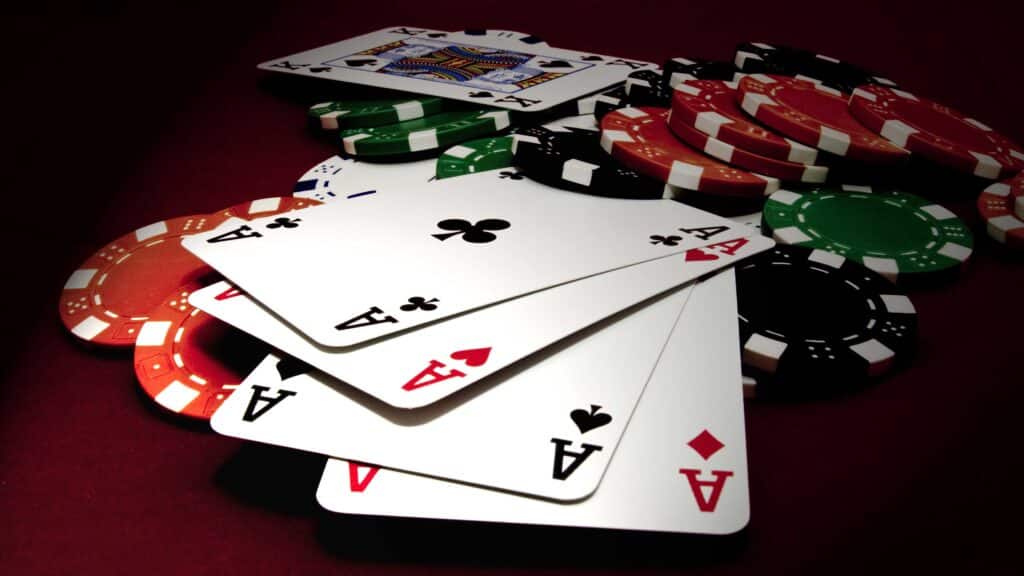
High-stakes pot-limit Omaha magnifies ordinary poker errors. Four hole cards create many connected combinations, equities run closer than they often appear, and the pot-limit betting structure allows the effective stack to enter rapidly. A hand that looks dominant on the flop can become fragile when the turn changes the nut advantage or creates stronger redraws.
The phrase “high stakes” should describe the financial exposure, not a different set of card rules. The professional task is to preserve decision quality while pots, variance and psychological pressure increase.
Start with the exact Omaha construction rule
Every final hand must use exactly two hole cards and exactly three community cards. Players coming from hold’em frequently misread boards by using one, three or four hole cards mentally. That mistake becomes expensive in large pots because apparent flushes, full houses and blockers may not exist.
PokerStars’ official Omaha rules also explain the pot-limit maximum: the player may call the current bet and then raise by the size of the resulting pot. Understanding that sequence is essential when calculating how quickly stacks can be committed.
Before acting, name the exact two-card combination that makes the current hand. Then identify the best possible opposing hand and which cards improve or counterfeit each side. This discipline prevents a broad statement such as “I have the nut flush draw” from hiding the absence of a useful redraw or the presence of a paired board.
For players still consolidating the basics, the Omaha rules and strategy guide should be mastered before high-stakes decisions are considered.
Evaluate nut potential and redraw structure
Raw hand strength is only part of PLO equity. A made straight without redraws can perform poorly against the same straight plus a flush draw and higher straight possibilities. Sets can be vulnerable on connected boards, while nut draws with additional blockers may retain equity against a wide range.
Consider a flop of J♠10♠4♦. A player holding A♠K♠Q♥9♥ has a made king-high straight and the nut flush draw. Another player with K♦Q♦9♣8♣ also has a king-high straight but no spade redraw. They currently share the same straight, yet their future equity differs sharply because the first hand can improve to the nut flush and may block important continuing hands.
Do not convert that example into a rule that every freeroll should be played for stacks. Stack depth, opponent range, board-pairing risk and possible higher redraws still matter. Run exact combinations after the session rather than relying on memory of the visible showdown.
Equity changes by street. A small flop advantage can become a large turn disadvantage when a board pair or suit arrives. Plan not only the current bet but which turn cards support betting, calling or stopping.
Use position to control pot geometry
Position provides more than the last decision. It reveals how many opponents continue, whether the effective stack has changed and whether a river bet is likely to be faced. Out of position, a hand with reasonable equity may realize less of it because later streets are difficult to navigate.
Pot-limit sizing creates geometric growth. With $1,000 in the pot and $4,000 effective stacks, a pot-sized bet and call make the next pot $3,000 with $3,000 remaining. One decision can therefore set up a full-stack river without an all-in bet on the flop.
| Street | Pot before action | Pot-size bet and call | Effective stack left |
|---|---|---|---|
| Flop | $1,000 | Pot becomes $3,000 | $3,000 |
| Turn | $3,000 | Pot-size shove can use remaining stack | $0 |
The table illustrates why a flop call is often a stack-plan decision. Before calling, identify the turn cards and bet sizes that will produce commitment. A player who discovers the stack-to-pot ratio only after the turn has surrendered control of the hand.
Position also improves bluff selection. Blockers matter only when the opponent can plausibly fold the hands being represented. A prestigious “nut blocker” is not a licence to bet into a range that remains too strong.
Price rake, table quality and edge honestly
At high nominal stakes, rake may consume a smaller percentage of very large pots, but caps, time charges and operator structures vary. Short-handed games can produce more contested pots and more frequent marginal decisions. Calculate the actual cost from statements rather than assuming high stakes automatically means low friction.
Game quality is usually more important than demonstrating technical sophistication. A difficult lineup can eliminate a small theoretical edge and increase variance. Seat position relative to aggressive or weak players changes the value of entering the game.
Track results by table type, stake, number of players and rake method. A positive aggregate can conceal losses in the toughest lineup while softer sessions generate all profit. Review the decision to sit as seriously as the hands played.
The broader discussion of poker variance is relevant because high-stakes samples are often small and financially dramatic. A few large pots can dominate months of results without proving the underlying strategy is sound.
Protect the bankroll from correlated risk
PLO variance is amplified by close equities, multiway pots and large stack commitments. A bankroll rule should account for the game’s actual standard deviation, personal income, access to replacement capital and the possibility that the lineup is tougher than estimated.
Do not treat every dollar available outside the poker account as bankroll. Living expenses, taxes and emergency savings serve different purposes. High-stakes play funded by money needed elsewhere creates pressure that can distort folds, table selection and session length.
Set exposure limits for simultaneous tables and unusually deep stacks. Two tables at 300 big blinds create more risk than two standard 100-big-blind tables even though the blind level is identical. Mark sessions in which effective stacks exceed the ordinary plan.
GambleRoad’s guide to advanced poker bankroll management explains why risk limits should change with format and uncertainty rather than follow one universal buy-in number.
Build a survival-oriented review process
High-stakes review should separate card distribution from controllable decisions. Tag hands for preflop construction, nut advantage, redraws, pot geometry, river blockers and table selection. Reconstruct ranges before looking at the result.
- Verify the exact two hole cards used in each claimed made hand.
- Calculate equity against a range, not only the actual showdown hand.
- Record the stack-to-pot ratio before each major decision.
- Review whether position allowed the equity to be realized.
- Include rake and time charges in the session result.
- Audit the decision to enter and remain in the lineup.
Stop rules should include deteriorating calculation, emotional urgency and unwillingness to leave a poor game. A financial loss limit alone can keep a player seated while decision quality has already collapsed.
High-stakes PLO rewards accurate construction, range work and disciplined game selection. It punishes confidence that is not supported by bankroll, position and redraw analysis. Survival is not a timid alternative to winning; it is the condition that allows a real edge to be observed over enough hands.
Private study groups and solvers can improve range work, but they should not become real-time assistance. Check the poker room’s current software policy and keep analysis outside active play. A model is valuable when it explains why a line works across ranges, not when it replaces awareness of the actual stack, opponent and rule set.